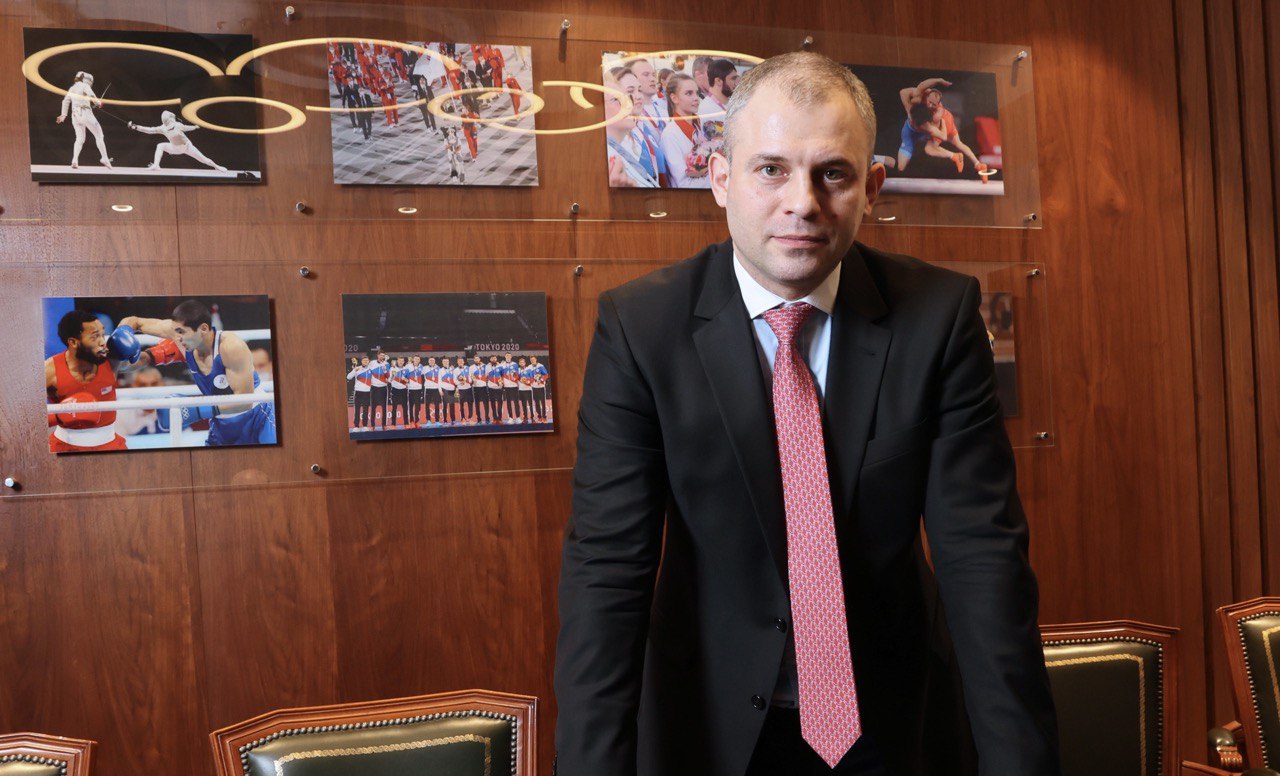


On December 20, the Olympic Assembly elected the governing bodies of the Russian Olympic Committee, including the new Secretary General of the ROC. Rodion Plitukhin, who had previously headed the Office of the President of ROC for several years and was also Deputy Director General of the organization, took over.
In an interview with the ROC’s Information Service, Rodion Gennadyevich shared insights on his initial experiences as the new Secretary General, his professional trajectory, progress of the Olympic movement in Russia, and collaborations with international entities.
– You celebrated this New Year already as Secretary General, and we congratulate you again. Please tell us about your path in the sports and Olympic movement.
– In his youth, my father Gennady Anatolyevich was a dedicated boxer, and our family resided in one of the North Caucasus republics. This put a certain imprint on the demanding and approach to my upbringing. However, circumstances aligned in such a way that I was able to balance my physical training with my studies, which also required me to maintain a certain level of fitness and readiness – not only for work but also for self-defense (laughs).
It was in 2004 when I first stepped into the ROC building. After the interview, I was hired as a specialist in the Russian Fencing Federation. Over time, I grew to the position of Executive Secretary, which is somewhat similar to my current role. To say it was interesting would be an understatement! One of my key responsibilities was to participate in initiatives aimed at promoting Russian candidates for leadership and other positions within international sports organizations. A lot of diplomatic work. Our efforts often involved challenging stereotypes and overcoming obstacles one step at a time, by providing partners and opponents with a more comprehensive understanding of our candidates. Our ultimate goal was to ensure that Russian representatives were elected to various bodies within international sports organizations. Of course, it took a well-oiled team to work on it. In addition to exceptional experience and knowledge, overall success brought a sense of exploration.
In 2009, I decided to pursue a second degree at the Foreign Ministry Diplomatic Academy, as I had long been interested in learning Italian. Prior to that, I simply did not have the time to dedicate to language studies.
This was followed by a logical change in the profile of activities. I had the opportunity to work side by side with the organizers and marketing partners of the Sochi 2014 Winter Games: I received an offer from Russian Railways, which has set up an interaction group with the Organizing Committee for the 2014 Olympic and Paralympic Games. A huge organization, practically 1.5 million employees at the time. Every day you learn something new. London missions (for the 2012 Olympics), Olympic construction in Sochi and Lake Baikal, the Olympic Torch Relay, and coverage of the creation of transportation infrastructure for Sochi 2014. At some point we even realized that we were defending the interests of the domestic industry by looking into the intricacies of the contracts with the IOC and OCOI. But it’s more of an emotional memory. On the whole, working life was much less full of “Olympic” and other romance.
After that, I worked in human resources consulting, and in 2017 Stanislav Aleekseevich Pozdnyakov, then the first Vice President of ROC, offered me a position with the Russian Olympic Committee, which involved an interesting and varied range of tasks. I didn’t think twice about it. As it turned out, “interesting and varied” is an understatement. At that time, there was already a lot of activity related to the allegations against Russia for doping violations.
A specially created anti-doping commission, the NOAC, worked actively and effectively in the ROC under the leadership of Vitaly Georgievich Smirnov, with the support of the head of the organization Alexander Dmitrievich Zhukov. The problems that we had to deal with were global in nature, directly affecting the fate of our sport.
The leaders then took on an enormous responsibility. Stanislav Alekseevich also took initiatives in a number of key areas, in particular by volunteering to lead the Olympic delegation to the PyeongChang Games in a situation where the ROC was involved while formally subject to a provisional suspension. There were numerous negotiations and countless obstacles to navigate, with circumstances often requiring us to come up with creative and unconventional solutions almost immediately. This often left little time for analysis or calculation, and it was not always possible to determine if we had found the best possible option.
– Didn’t you also work together with Stanislav Alekseevich in the European Fencing Confederation?
– At the time Stanislav Alekseevich was elected First Vice President of the Russian Olympic Committee, he had been head of the European Fencing Confederation for about a year, and I had already had the opportunity to work as a volunteer assistant to the President. As part of my role, I was tasked with managing the interaction between the Executive Committee, commissions, and member federations, while also seeking out the most effective forms of cooperation with external entities, such as the structures within the European Union.
– As of 2019, you are a member of one of the IOC commissions…
– Yes, the International Olympic Committee leadership decided to include me in the “Sport and Active Society” commission, which was a kind of successor to the “Sport for All” commission. Today, its functions have been incorporated into a commission known as “Olympism-365” in English-speaking manner. The emphasis is that 365 days a year we are immersed in Olympism and sports, promoting, propagating Olympic values and looking for ways, real opportunities to make the world a better place through sports. As a rule, the composition of the commission is renewed annually. At the moment I am still in it.
– Is the position of Secretary General of the ROC a principally new stage for you, a big challenge?
– Not only is it an honorable and extremely responsible position, it is a really stressful one, even in normal times, requiring maximum involvement. This includes international work, internal communications, interaction and coordination with our member organizations and industry colleagues, and more.
– It seems that your nomination as Secretary General was an organic continuation of the work begun earlier. What will now be the scope of your work?
– Everything concerning the work of the governing bodies of the Russian Olympic Committee, including the Olympic Assembly, the organization of control over the implementation of the decisions of these bodies and the coordination of the entrusted units and public formations of the ROC. Now special attention is paid to the preparation of the Olympic reserve, the future of national high-performance sports. The focus of the work also includes a significant expansion of interaction with our Olympic Councils, which are represented in all regions of the country. This is one of the areas with the highest potential. Not all subjects yet have equally developed management approaches and organized work for objective reasons. Our task, among other things, is to help set up the most effective work, leveraging the capabilities of ROC and related structures.
And, of course, international activities based on the relevant provisions of the Concept of Russian Humanitarian Policy Abroad approved by Russian President Vladimir Vladimirovich Putin.
– Over the past few months, the international activities of the ROC have been under close scrutiny at many different levels. What allows you to maintain a high level of contacts, the intensity of negotiations, even in the current difficult political situation?
– When building a relationship and interaction with anyone, you need to make sure that the other party knows how to not only talk, but is willing to listen. And you, in turn, are determined to listen to your interlocutor, to draw objective conclusions. You have to be really friends with your friends. By adhering to this principle yourself and persuading others to do the same, you can get to mutually beneficial outcomes both immediately and over time. And communication will go in the right way. Of course, it does not always work, but a negative result is also a result.
As long as there is a mutual interest in achieving a useful result, as long as there is the possibility to accomplish tasks with a reasonable calculation of resources, time, effort and money, it will be possible to find a compromise even in the most difficult situations. Take the equipment of our teams in Tokyo and Beijing…
– Is it correct to say that the ROC will take every opportunity to achieve the necessary goals as long as people are truly willing to listen, communicate and seek solutions regardless of the political environment.
– More than that, even if people lose this willingness at some point under the pressure of some forces, we will do our best to give them that willingness back. The task is precisely to find points of reference that make it possible to change the position of the opponent, at least to some extent, and perhaps in the future achieve a more constructive relationship and begin to talk about interaction rather than contradictions.
We are in one of the most difficult situations today. Nevertheless, we see the importance that a particular cultural phenomenon like sport and the international Olympic movement have for humanitarian cooperation. If sports can help make our imperfect world a better place, we are willing to do our best to make it happen with the active constructive role of our homeland, which we are proud to represent.
– One of the main tasks for today is the return of our athletes to international competitions. How is the situation developing now?
– At the end of February last year, in our opinion – and we have never concealed this – the international sports community took an extremely radical and unbalanced position. There were a number of meetings where my colleagues and I informally discussed possible options. Through various consultations and negotiations – direct and indirect – the Russian Olympic Committee and the National Olympic Committee of the Republic of Belarus fully participated in the General Assembly of the Association of National Olympic Committees in South Korea in October. Almost all the NOCs were represented there, with a few exceptions. The meeting in Seoul proved to be insightful, as the majority of our colleagues were not only accepting of the idea, but also in favor of allowing Russian and Belarusian athletes to participate. The belief was that their participation would help to restore the integrity, competitiveness, and overall spectacle of the competition.
This was followed by another series of consultations, after which the President of the ROC attended the Olympic Summit in December in person. When the question of extending the so-called sanctions against the governments of Russia and Belarus was put to a vote, there was an overwhelming majority in favor. Naturally, with the exception of the Russian Olympic Committee and representatives of several other organizations. But the return of Russians and Belarusians to international sports competitions was supported unanimously.
The most important thing we want to convey to our colleagues at the IOC is that the continuation of the “dividing line” will only contribute to the disintegration of the modern international Olympic and sporting movement. Today, quite powerful attempts to split our sports family to please specific political customers have renewed with renewed vigor. And this demonstrative destruction of sporting relations will, of course, get us nowhere if we do not respond adequately to these kinds of challenges. I am not only talking about representatives of unfriendly jurisdictions, such actions are also characteristic of certain representatives of our professional and semi-professional community who call for radical politicized steps. Here you can turn to experts in the sports industry. They quite reasonably argue: if you want to kill high-performance sports in Russia, the first step you need to take is to proactively stop international sports cooperation and any competitive activity at the international level. So you will gradually come to the fact that the average level of sport will be reduced to zero, and then the areas of popular sport and publicly accessible children’s sport will be up for disposition.
– Speaking of children’s sports. ROC acts as a founder of the International Sports Games “Children of Asia”. How important is it for the Russian Olympic Committee, what are the goals in the medium and long term?
– We shouldn’t just sit back and wait to go back to international competitions. Let’s continue to achieve this by all available means. At the same time, it is necessary to develop and implement new competition formats. “Children of Asia” – the only international complex competition, which, despite all bans and restriction, was held in July 2022 in Vladivostok, in the Russian Federation, under the auspices of the IOC. Representatives from 13 countries came there, and several federal districts of our country were represented. The Winter Games in Kuzbass ended just as successfully. Again, we saw a large number of participating countries. It’s very nice that our Belarusian friends came to the Games for the first time. In fact, the Games now have a Eurasian status. The competition was held at a high level, in an atmosphere of friendship, respect, fair competition – true Olympic values. There were a huge number of additional outreach, educational projects for the participants and their surroundings. All goals and objectives for this type of event were realized and achieved.
The “Children of Asia” Games project will continue to evolve! The ROC is ready to support this direction. We try to take a holistic approach to preparations and integrate our most important projects into the Games, such as the International Forum of Young Olympians, which has traditionally been held in Moscow since 2018. We expect that in 2024 the forum will be implemented in some updated, perhaps multiday format.
– You have been in the Olympic movement for many years, you have had time to work in various positions, but Olympism, of course, is first and foremost. Which were your most memorable Olympic Games?
– Perhaps this question is for athletes and coaches, because they are the main actors. All the support of the Russian Olympic Committee serves to set a positive example to the world for younger generations to follow.
The essence of Olympism is to gain moral and spiritual satisfaction through overcoming difficulties. To quote Stanislav Alexeyevich Pozdnyakov, who is quite serious about mountaineering and once described his ascent of the seven-thousand-meter peak thus: “The climb is an amazing combination of unpleasant and useless, but the physical fatigue has passed, and the moral satisfaction remains for a long time”.
So at this point I will not single out any particular Olympic Games. Favorite will be the next summer Games, which will be successfully held in our country.